
India’s rapidly growing private space sector recently achieved a major milestone with the successful launch of Mission Drishti, the country’s first privately built synthetic aperture radar (SAR) imaging satellite developed by Bengaluru-based startup GalaxEye. The mission attracted national attention because it represented another important step in India’s expanding commercial space ecosystem and demonstrated the increasing capabilities of domestic private aerospace companies.
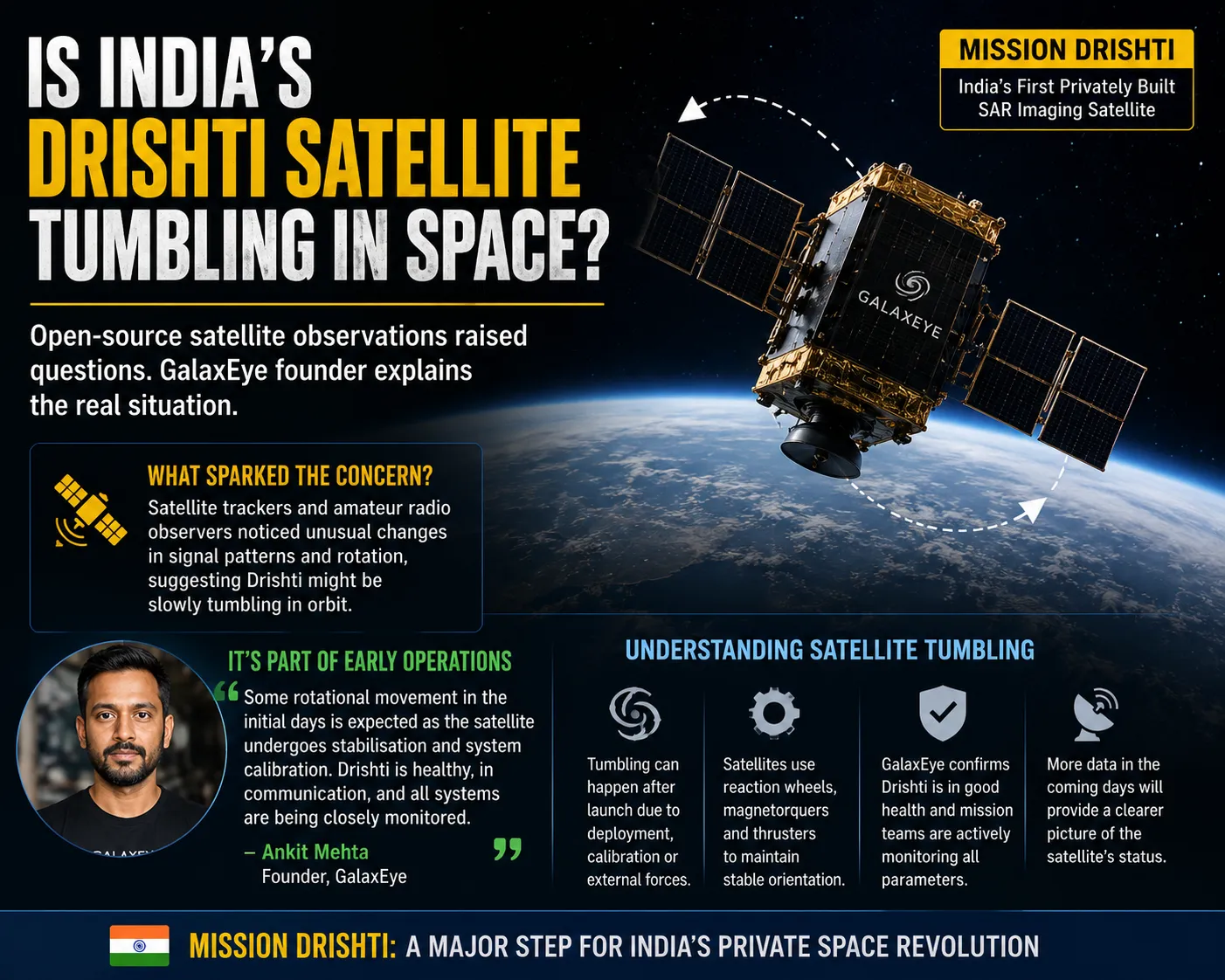
However, only days after launch, discussions began emerging online after open-source satellite observers and amateur radio trackers suggested that the spacecraft might be slowly tumbling in orbit. The speculation quickly spread across social media and space-tracking communities, leading to growing curiosity about the satellite’s condition and operational status.
As questions intensified, GalaxEye’s founder and company representatives publicly addressed the concerns, explaining the technical situation surrounding Mission Drishti and clarifying whether the satellite was facing any serious stability issues.
The episode has now sparked broader discussions about satellite deployment challenges, orbital stabilisation systems, space mission transparency, and the increasing role of independent satellite tracking communities in monitoring modern space missions.
What Is Mission Drishti?
Mission Drishti is considered a landmark project for India’s private space industry because it is the country’s first privately developed synthetic aperture radar imaging satellite. Unlike traditional optical satellites that rely on sunlight and clear weather conditions, SAR satellites use radar technology to capture Earth imagery regardless of cloud cover, darkness, rain, or atmospheric conditions.
This capability makes SAR technology extremely valuable for applications such as:
-
Disaster monitoring
-
Border surveillance
-
Agriculture mapping
-
Flood assessment
-
Urban planning
-
Environmental monitoring
-
Defence intelligence
GalaxEye designed Mission Drishti to strengthen India’s independent Earth observation capabilities while showcasing the growing technical maturity of the nation’s private aerospace sector.
The satellite launch represented years of engineering, testing, funding, and technological development by the Bengaluru-based startup, which has emerged as one of India’s promising space-tech companies.
Why Questions About Tumbling Started Emerging
Shortly after Mission Drishti entered orbit, open-source satellite trackers and amateur observers began analysing publicly available orbital data and radio signal behaviour associated with the spacecraft.
Some observers claimed the satellite’s changing signal patterns and rotational characteristics suggested that the spacecraft might be slowly tumbling instead of maintaining stable orientation control. In satellite operations, tumbling refers to uncontrolled or partially controlled rotational movement in space.
Tumbling can occur for several reasons, including:
-
Post-launch stabilisation delays
-
Attitude control system calibration
-
Power distribution adjustments
-
Thruster configuration phases
-
External orbital forces
-
Minor technical anomalies
Because satellite tracking data is often publicly monitored by independent space enthusiasts worldwide, unusual movement patterns can quickly trigger speculation online.
The growing visibility of citizen-led space observation networks has significantly increased public awareness of satellite operations, but it has also sometimes led to premature conclusions before official confirmations become available.
GalaxEye Founder Clarifies the Situation
As discussions intensified, GalaxEye’s founder publicly responded to the speculation regarding Mission Drishti’s stability. According to company representatives, the satellite was undergoing expected early operational procedures and orbital adjustments after deployment.
The company clarified that some rotational movement observed by external trackers was not necessarily abnormal during initial mission phases. Spacecraft launched into orbit often require time to stabilise orientation, calibrate systems, deploy components, and complete attitude-control operations before reaching full operational configuration.
GalaxEye reportedly stated that Mission Drishti remained in communication with ground systems and that mission teams were actively monitoring spacecraft performance.
The company also suggested that observations made by independent trackers may not fully represent the complete operational picture because satellite telemetry and internal diagnostics provide more accurate technical assessments than external visual or radio-based observations alone.
The response helped calm some concerns while also highlighting how complex spacecraft stabilisation processes can be during the first days after launch.
Understanding Satellite Tumbling in Space
Satellite tumbling is not always a sign of mission failure. In many cases, newly launched spacecraft experience temporary rotational motion during deployment or while transitioning into stable operational orientation.
Modern satellites rely on advanced attitude control systems to maintain proper positioning in orbit. These systems often include:
-
Reaction wheels
-
Magnetorquers
-
Thrusters
-
Gyroscopes
-
Star trackers
-
Control algorithms
The purpose of these systems is to ensure the satellite remains correctly oriented for communication, solar power generation, thermal management, and imaging operations.
When a spacecraft rotates uncontrollably for extended periods, it can create operational risks such as:
-
Communication disruptions
-
Power generation instability
-
Imaging errors
-
Thermal imbalance
-
Navigation problems
-
Component stress
However, controlled or partially managed rotational movement during initial orbital operations can sometimes be part of expected mission procedures.
This is why aerospace companies carefully analyse telemetry data before determining whether any movement represents a serious anomaly.
Why Mission Drishti Matters for India’s Space Industry
The attention surrounding Mission Drishti reflects the growing importance of India’s private space sector. In recent years, India has rapidly expanded its commercial space ecosystem following policy reforms that encouraged private participation in satellite development, launch services, and space technology innovation.
Companies like GalaxEye are now helping position India as a competitive player in the global space economy alongside established international aerospace firms.
Mission Drishti is especially important because SAR technology remains one of the most strategically valuable forms of Earth observation capability. Unlike optical satellites, radar imaging systems can operate continuously under difficult environmental conditions.
For countries like India, this capability offers major advantages in areas such as:
-
National security
-
Climate monitoring
-
Natural disaster response
-
Agricultural planning
-
Infrastructure management
-
Maritime surveillance
The successful operation of Mission Drishti could therefore become a major technological milestone for India’s domestic private satellite industry.
The Rise of Open-Source Satellite Tracking Communities
One fascinating aspect of this controversy is the growing influence of independent satellite tracking communities. Around the world, amateur astronomers, radio operators, and open-source intelligence enthusiasts regularly monitor spacecraft using publicly accessible tools and observational methods.
These communities often analyse:
-
Orbital paths
-
Signal transmissions
-
Rotational behaviour
-
Brightness changes
-
Deployment activity
-
Ground-station communications
In some cases, independent trackers have successfully identified spacecraft anomalies before official announcements. However, open-source observations can also sometimes generate inaccurate speculation due to limited access to full mission telemetry.
The Mission Drishti discussion demonstrates how space missions today operate in an environment of unprecedented public visibility. Even private satellites are now constantly observed by global online communities interested in aerospace activity.
This increased transparency creates both opportunities and challenges for commercial space companies managing public communication during sensitive mission phases.
Challenges Faced by Newly Launched Satellites
Launching a satellite into orbit is only the beginning of a much longer and technically demanding process. After separation from the launch vehicle, spacecraft must complete multiple critical tasks before becoming fully operational.
-
These often include:
-
Solar panel deployment
-
Antenna activation
-
System diagnostics
-
Thermal stabilisation
-
Attitude control calibration
-
Communication testing
-
Orbit correction manoeuvres
-
Payload activation
Any small issue during these early stages can affect spacecraft behaviour temporarily. Even experienced global space agencies occasionally encounter stabilisation or orientation challenges after launches.
This is why aerospace engineers closely monitor satellites during the first few days and weeks after deployment. The early mission phase is often considered one of the most sensitive periods of any space operation.
For private startups like GalaxEye, these operations are even more significant because every mission contributes directly to the company’s reputation, technical credibility, and future investment potential.
Why Public Communication Is Important in Modern Space Missions
The rapid spread of speculation surrounding Mission Drishti also highlights the growing importance of transparent public communication in modern space operations.
Today’s space missions unfold under constant global observation through social media, satellite tracking networks, and online aerospace communities. Delays in official clarification can quickly lead to rumours, misinformation, or exaggerated concerns.
GalaxEye’s quick response helped demonstrate the importance of proactive communication during technically sensitive mission stages. By addressing the speculation directly, the company reassured observers while also educating the public about how spacecraft stabilisation processes work.
As India’s private space industry grows, communication strategies will likely become increasingly important alongside engineering expertise.
The Future of India’s Private Space Sector
Despite the temporary concerns surrounding Mission Drishti, the mission itself remains an important achievement for India’s growing commercial space ecosystem.
India has rapidly emerged as one of the world’s most promising space-tech markets due to:
-
Government support
-
Cost-efficient engineering
-
Skilled scientific talent
-
Growing startup investment
-
Expanding launch infrastructure
-
International collaboration opportunities
Private companies are now playing a larger role in satellite manufacturing, launch systems, Earth observation, defence technologies, and deep-space innovation.
Mission Drishti symbolizes this broader transformation. Regardless of the temporary speculation surrounding orbital stability, the satellite represents a major technological milestone for Indian private aerospace development.
Final Thoughts
The debate over whether GalaxEye’s Mission Drishti satellite was slowly tumbling in orbit has drawn widespread attention not only because of the mission itself but also because it reflects the changing nature of modern space exploration.
Open-source observers, independent satellite trackers, and online aerospace communities now monitor spacecraft activity in real time, creating unprecedented transparency around space missions. While this visibility increases public engagement, it can also amplify technical speculation before official information becomes available.
GalaxEye’s response clarified that Mission Drishti remains under active monitoring and that early-stage spacecraft movement does not automatically indicate mission failure.
More importantly, the mission represents a historic step forward for India’s private space sector. As companies like GalaxEye continue developing advanced technologies such as SAR imaging satellites, India’s role in the global space economy is expected to grow significantly in the years ahead.
newstapy.com newstapy.com newstapy.com newstapy.com newstapy.com newstapy.com newstapy.com newstapy.com newstapy.com newstapy.com newstapy.com newstapy.com newstapy.com newstapy.com newstapy.com newstapy.com newstapy.com newstapy.com newstapy.com newstapy.com newstapy.com newstapy.com newstapy.com newstapy.com newstapy.com newstapy.com newstapy.com newstapy.com newstapy.com newstapy.com newstapy.com newstapy.com newstapy.com newstapy.com newstapy.com newstapy.com newstapy.com newstapy.com newstapy.com newstapy.com newstapy.com newstapy.com newstapy.com newstapy.com newstapy.com newstapy.com newstapy.com newstapy.com newstapy.com newstapy.com newstapy.com newstapy.com newstapy.com newstapy.com newstapy.com newstapy.com newstapy.com newstapy.com newstapy.com newstapy.com newstapy.com newstapy.com newstapy.com newstapy.com newstapy.com newstapy.com newstapy.com newstapy.com newstapy.com newstapy.com newstapy.com newstapy.com newstapy.com newstapy.com newstapy.com newstapy.com newstapy.com newstapy.com newstapy.com newstapy.com newstapy.com newstapy.com newstapy.com newstapy.com newstapy.com newstapy.com newstapy.com newstapy.com newstapy.com newstapy.com newstapy.com newstapy.com newstapy.com newstapy.com newstapy.com newstapy.com newstapy.com newstapy.com newstapy.com newstapy.com newstapy.com newstapy.com newstapy.com newstapy.com newstapy.com newstapy.com newstapy.com newstapy.com newstapy.com newstapy.com newstapy.com newstapy.com newstapy.com newstapy.com newstapy.com newstapy.com newstapy.com newstapy.com newstapy.com newstapy.com newstapy.com newstapy.com newstapy.com newstapy.com newstapy.com newstapy.com newstapy.com newstapy.com newstapy.com newstapy.com newstapy.com newstapy.com newstapy.com newstapy.com newstapy.com newstapy.com newstapy.com newstapy.com newstapy.com newstapy.com newstapy.com newstapy.com newstapy.com newstapy.com newstapy.com newstapy.com newstapy.com newstapy.com newstapy.com newstapy.com newstapy.com newstapy.com newstapy.com newstapy.com newstapy.com newstapy.com newstapy.com newstapy.com newstapy.com newstapy.com newstapy.com newstapy.com newstapy.com newstapy.com newstapy.com newstapy.com newstapy.com


