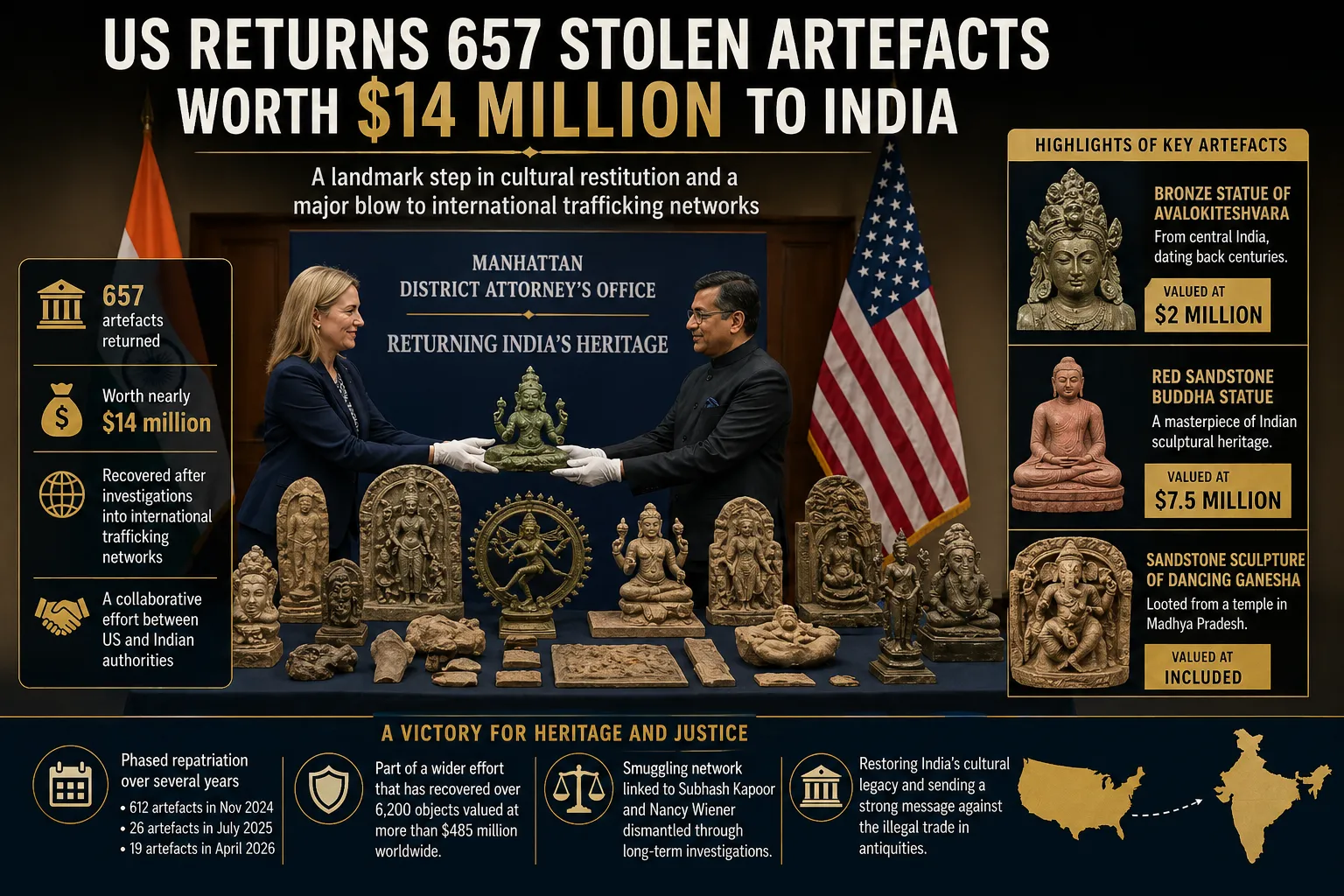
The recent return of 657 stolen artefacts from the United States to India marks one of the most significant cultural restitution efforts in recent years. Valued at nearly $14 million, these antiquities were recovered after extensive investigations into international trafficking networks.
The initiative, led by the Manhattan District Attorney’s Office in collaboration with multiple agencies, highlights both the scale of global cultural theft and the growing commitment to restoring heritage to its rightful origins.
This development is not just a diplomatic success; it is also a powerful reminder of the importance of protecting cultural identity in an increasingly interconnected world.
The Scale of the Recovery
The repatriation of 657 artefacts reflects the magnitude of cultural property theft that has taken place over decades. These items, ranging from ancient sculptures to religious icons, were smuggled out of India through sophisticated trafficking networks and eventually ended up in private collections, galleries, and auction houses abroad.
Authorities have emphasized that this is part of a broader effort. The Manhattan District Attorney’s Antiquities Trafficking Unit has, over the years, recovered more than 6,200 cultural objects valued at over $485 million, returning thousands of them to countries across the world.
The return of such a large number of artefacts in a single operation demonstrates how deeply entrenched these illegal networks have been and how coordinated international action is essential to dismantle them.
Key Artefacts and Their Historical Value
Among the returned items are several culturally and historically significant pieces that reflect India’s rich artistic traditions:
-
A bronze statue of Avalokiteshvara, valued at around $2 million, originally from central India and dating back centuries.
-
A red sandstone Buddha statue worth approximately $7.5 million, representing a classic example of Indian sculptural heritage.
-
A sandstone sculpture of a dancing Ganesha, looted from a temple in Madhya Pradesh and trafficked through illegal channels.
These artefacts are not merely objects of art; they are deeply tied to India’s religious, cultural, and historical identity. Their return restores not only physical items but also a part of the nation’s collective memory.
The Role of Smuggling Networks
The investigation into these artefacts uncovered extensive trafficking operations linked to notorious figures such as Subhash Kapoor and Nancy Wiener. These networks operated across multiple countries, sourcing artefacts from temples and archaeological sites in South and Southeast Asia before selling them in Western markets.
In many cases, the artefacts were accompanied by forged documentation to create a false sense of legitimacy. Auction houses and private collectors often acquired these items without fully verifying their provenance, allowing the illegal trade to flourish.
The dismantling of such networks has been a long and complex process, involving years of investigation, international cooperation, and legal action. Kapoor, for instance, has been convicted in India and is facing further legal proceedings abroad, illustrating the global nature of these crimes.
International Cooperation and Law Enforcement Efforts
The successful recovery of these artefacts underscores the importance of collaboration between countries and institutions. The effort involved not only the Manhattan District Attorney’s Office but also agencies such as Homeland Security Investigations and Indian authorities.
This partnership has proven crucial in tracing stolen artefacts, identifying their origins, and ensuring their return. Officials have noted that such cooperation is essential to combat the illegal trade in antiquities, which often spans multiple jurisdictions and involves complex legal challenges.
The repatriation ceremony held in New York symbolizes this collaborative spirit, demonstrating how shared responsibility can lead to meaningful outcomes in preserving global heritage.
Phased Repatriation and Long-Term Efforts
The return of the 657 artefacts did not happen overnight. It was carried out in phases over several years:
-
612 items were returned in November 2024
-
26 items in July 2025
-
The final batch of 19 artefacts was handed over in April 2026
This phased approach reflects the meticulous process involved in verifying ownership, completing legal formalities, and ensuring proper documentation. Each artefact must be carefully traced back to its origin before it can be officially returned.
Despite this progress, authorities have acknowledged that the work is far from complete. More than 1,000 stolen artefacts are still believed to be awaiting recovery, indicating that the fight against cultural theft continues.
The Impact on India’s Cultural Heritage
The return of these artefacts has significant cultural and emotional importance for India. Many of the items were originally housed in temples, museums, or historical sites, where they played a role in religious practices and community identity.
Their absence often leaves a cultural void, disconnecting communities from their heritage. Repatriation helps restore this connection, allowing future generations to engage with their history in a tangible way.
Furthermore, the return of these artefacts strengthens India’s efforts to protect its cultural assets. It also sends a strong message that stolen heritage will not remain hidden indefinitely and that international systems are increasingly aligned to address such injustices.
Broader Implications for the Global Art Market
This case also raises important questions about the global art market and the responsibilities of collectors, dealers, and institutions. The presence of stolen artefacts in reputable collections highlights the need for stricter due diligence and transparency.
In recent years, there has been growing pressure on museums and private collectors to verify the provenance of artefacts and return items that were acquired through questionable means. The restitution of these 657 artefacts is part of a broader global trend toward accountability and ethical practices in the art world.
It also emphasizes the importance of documentation, digital tracking, and international agreements in preventing future thefts.
Conclusion
The return of 657 stolen artefacts worth $14 million to India represents a major milestone in the ongoing effort to reclaim cultural heritage. It showcases the effectiveness of sustained investigation, international cooperation, and legal action in addressing the complex issue of antiquities trafficking.
More importantly, it highlights the enduring value of cultural heritage—not just as art, but as a living connection to history, identity, and tradition.
While significant progress has been made, the journey is far from over. Thousands of artefacts remain untraced, and trafficking networks continue to operate in various forms. However, this restitution serves as a powerful example of what can be achieved when nations work together to protect and preserve humanity’s shared legacy.
pulsitera.shop pulsitera.shop pulsitera.shop pulsitera.shop pulsitera.shop pulsitera.shop pulsitera.shop pulsitera.shop pulsitera.shop pulsitera.shop pulsitera.shop pulsitera.shop pulsitera.shop pulsitera.shop pulsitera.shop pulsitera.shop pulsitera.shop pulsitera.shop pulsitera.shop pulsitera.shop pulsitera.shop pulsitera.shop pulsitera.shop pulsitera.shop pulsitera.shop pulsitera.shop pulsitera.shop pulsitera.shop pulsitera.shop pulsitera.shop pulsitera.shop pulsitera.shop pulsitera.shop pulsitera.shop pulsitera.shop pulsitera.shop pulsitera.shop pulsitera.shop pulsitera.shop pulsitera.shop pulsitera.shop pulsitera.shop pulsitera.shop pulsitera.shop pulsitera.shop pulsitera.shop pulsitera.shop pulsitera.shop pulsitera.shop pulsitera.shop pulsitera.shop pulsitera.shop pulsitera.shop pulsitera.shop pulsitera.shop pulsitera.shop pulsitera.shop pulsitera.shop pulsitera.shop pulsitera.shop pulsitera.shop pulsitera.shop pulsitera.shop pulsitera.shop pulsitera.shop pulsitera.shop pulsitera.shop pulsitera.shop pulsitera.shop pulsitera.shop pulsitera.shop pulsitera.shop pulsitera.shop pulsitera.shop pulsitera.shop pulsitera.shop pulsitera.shop pulsitera.shop pulsitera.shop pulsitera.shop pulsitera.shop pulsitera.shop pulsitera.shop pulsitera.shop pulsitera.shop pulsitera.shop pulsitera.shop pulsitera.shop pulsitera.shop pulsitera.shop pulsitera.shop pulsitera.shop pulsitera.shop pulsitera.shop pulsitera.shop pulsitera.shop pulsitera.shop pulsitera.shop pulsitera.shop pulsitera.shop pulsitera.shop pulsitera.shop pulsitera.shop pulsitera.shop pulsitera.shop pulsitera.shop pulsitera.shop pulsitera.shop pulsitera.shop pulsitera.shop pulsitera.shop pulsitera.shop pulsitera.shop pulsitera.shop pulsitera.shop pulsitera.shop pulsitera.shop pulsitera.shop pulsitera.shop pulsitera.shop pulsitera.shop pulsitera.shop pulsitera.shop pulsitera.shop pulsitera.shop pulsitera.shop pulsitera.shop pulsitera.shop pulsitera.shop pulsitera.shop pulsitera.shop pulsitera.shop pulsitera.shop pulsitera.shop pulsitera.shop pulsitera.shop pulsitera.shop pulsitera.shop pulsitera.shop pulsitera.shop pulsitera.shop pulsitera.shop pulsitera.shop pulsitera.shop pulsitera.shop pulsitera.shop pulsitera.shop pulsitera.shop pulsitera.shop pulsitera.shop pulsitera.shop pulsitera.shop pulsitera.shop pulsitera.shop pulsitera.shop pulsitera.shop pulsitera.shop pulsitera.shop pulsitera.shop pulsitera.shop pulsitera.shop pulsitera.shop pulsitera.shop pulsitera.shop pulsitera.shop pulsitera.shop pulsitera.shop
infinityinspires.com codecraftes.com linklaunches.com pixelperkes.com quantumquestes.com sunshinstates.com techsthrive.com webeswhiz.com webswisdoms.com